Systematic motion-space expansion
FrameNet frames and lexical units become scalable Frame–LU motion seeds instead of one-off scripts.
Accepted to CoRL 2026
Overview
HiPHI turns motion capture into motion-space design. FrameNet-guided motion seeds systematically expand across direction, speed, amplitude, posture, body-part involvement, and object/contact conditions—creating broad, repeatable coverage at unprecedented scale.
FrameNet frames and lexical units become scalable Frame–LU motion seeds instead of one-off scripts.
Synchronized human motion, object trajectories, and object meshes preserve the full physical interaction.
Coverage, quality, tracking, scaling, and real-world G1 deployment connect data directly to humanoid learning.
Motion Atlas
Explore the dataset-balanced shared embedding used to compare representative motion datasets under one unified kinematic protocol. HiPHI reaches more regions and distributes motion more broadly across them.
Frame–LU construction
A frame defines an event type and a lexical unit identifies the word sense that evokes it. Every Frame–LU pair becomes a family of motions, expanded across path, direction, speed, rhythm, amplitude, posture, body-part involvement, support, and object/contact conditions.
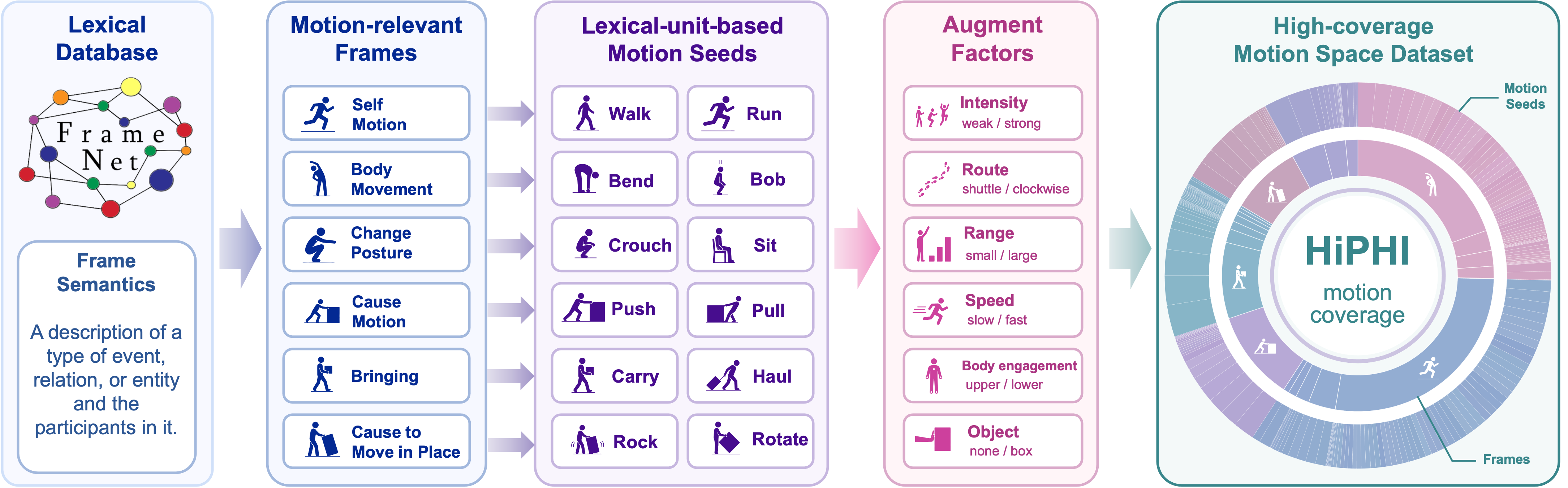
Select a Frame–LU chip to inspect a representative motion preview.
Physically grounded interaction
HiPHI captures full-body motion together with mesh-level object trajectories, preserving the geometry, load, inertia, resistance, and contact that shape executable humanoid behavior.
Humanoid learning
HiPHI achieves the highest matched-budget tracking success rates and fastest convergence, keeps improving as training data scales from 3 to 300 hours, and transfers to real hardware across running, sitting, crawling, carrying, flipping, and pulling.
Data scaling
Unmirrored HiPHI training data · mean MPJPE across 10 runs · lower is better
Benchmark
HiPHI spans the broadest kinematic region in the benchmark, leads every reported body-motion quality metric, delivers strong human-object geometric consistency, and turns scale into measurable tracking gains.
Lower jerk, acceleration, ground penetration, floating, and support-point drift.
Massive interaction scale with strong non-conflict and near-surface grounding.
Compact numeric tables for exact comparison.
Release
The 617.5-hour release combines high-fidelity BVH motion, synchronized object trajectories and meshes, Frame–LU indexing, natural-language descriptions, and rich metadata in one unified resource for humanoid learning.
ModalityNet Open Research License v1.0 for non-commercial scientific research, education, and evaluation.
@article{ji2026hiphi,
  title={HiPHI: A Large-Scale Benchmark for High-Precision Human Motion and Object-Interaction},
  author={Ji, Jiahao and Ma, Ji and Zhang, Runhan and Yu, Runyi and Wang, Wenjia and Chi, Weiheng and Peng, Qianqian and Yan, Weichao and Gu, Yongfei and Tian, Ye and Wu, Ting and Li, Longwei and Yuan, Chun and Dai, Ruoli and Han, Lei},
  journal={arXiv preprint arXiv:2608.16222},
  year={2026}
}